
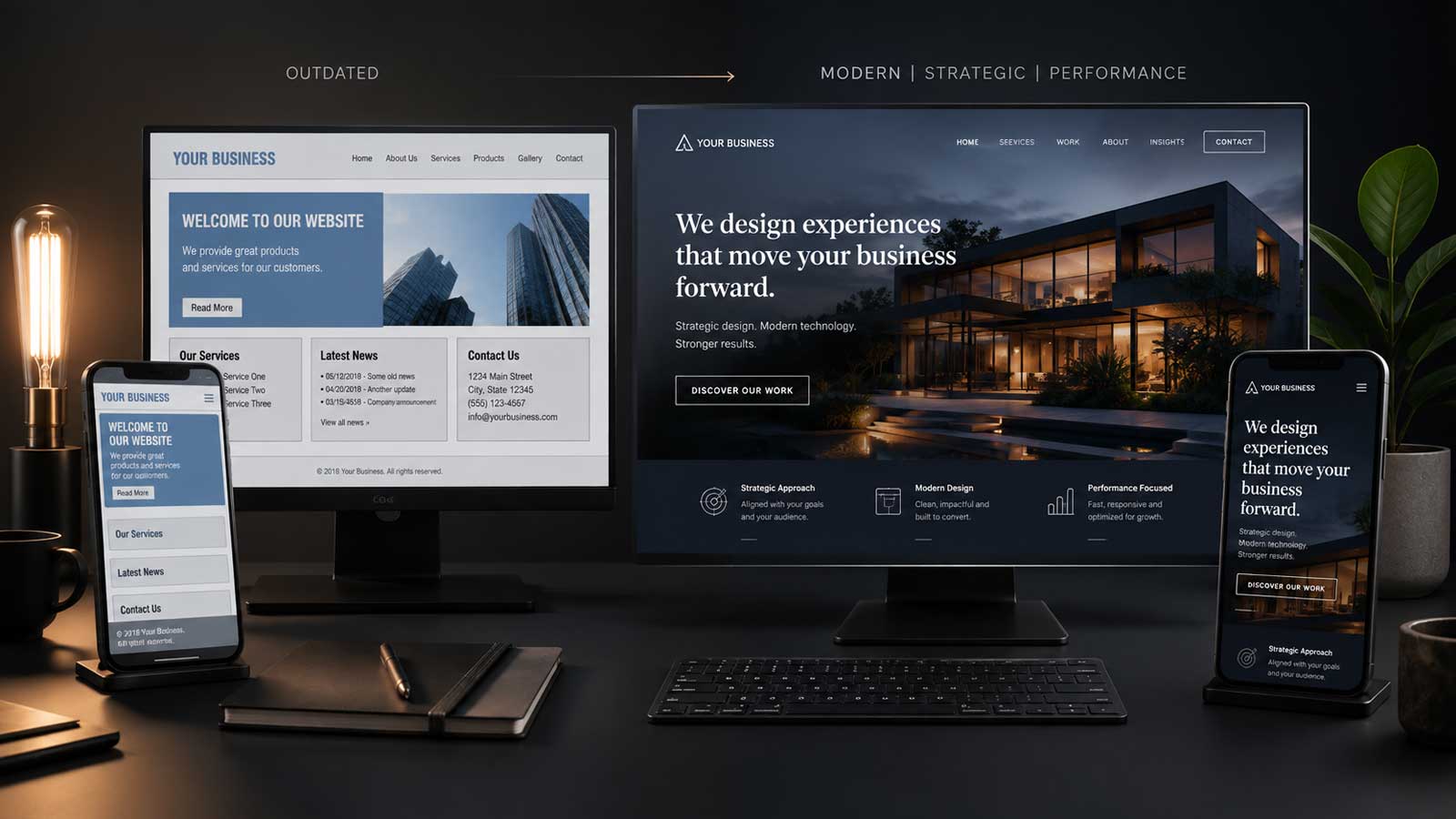
When Does a Business Website Need a Redesign?
A business website does not need to be redesigned simply because it is a few years old. What matters is whether it still works effectively for your visitors, represents your business accurately, performs well across devices, and supports your current marketing goals.
Sometimes the warning signs are obvious. In other cases, a website can still look acceptable while creating problems with navigation, mobile usability, search visibility, performance, or conversions.
Here are seven signs that can indicate it is time to consider a website redesign.
1. Your Website Looks Outdated Compared With Your Business
Visual design affects how visitors perceive a company before they read much of its content. An outdated layout, inconsistent typography, old imagery, crowded sections, or design patterns from an earlier generation of websites can make an established business appear less current than it really is.
This becomes especially important when the business itself has evolved. Your services, positioning, customers, or level of expertise may have changed while the website still represents an earlier version of the company.
A redesign should not simply make a website look newer. It should bring the visual experience into alignment with the business you are today.
2. The Mobile Experience Is Difficult to Use
A responsive website should do more than shrink desktop content onto a smaller screen. Navigation, typography, buttons, spacing, images, forms, and calls to action all need to work naturally on mobile devices.
Common warning signs include text that is difficult to read, buttons that are too close together, horizontal scrolling, oversized images, awkward menus, or sections that become excessively long on a phone.
If visitors have to zoom, search for navigation controls, or struggle to complete basic actions, the mobile experience has become a strong reason to evaluate a business website redesign.
3. Your Website Feels Slow
Performance is part of user experience. Visitors should not have to wait unnecessarily for large images, scripts, animations, videos, or third-party features before they can interact with a page.
However, redesigning a website is not automatically the solution to every speed problem. Sometimes optimization alone can significantly improve performance.
A redesign becomes more appropriate when performance issues are tied to the site’s underlying structure: an outdated theme, excessive plugins, inefficient layouts, accumulated code, or features that have been added over many years without a clear system.
This distinction matters because the goal should be to solve the actual problem rather than replace a website unnecessarily.
4. Visitors Have Trouble Finding What They Need
As businesses grow, websites often grow with them. New services, pages, landing pages, projects, resources, and menu items are added gradually. Eventually, the original site architecture may no longer reflect how visitors actually search for information.
Signs of a navigation problem can include:
- Too many competing menu options.
- Important services buried several clicks deep.
- Pages that overlap in purpose.
- Calls to action that are difficult to identify.
- Visitors repeatedly asking for information that already exists on the website.
A redesign provides an opportunity to reconsider the information architecture rather than simply changing colors and images.
This is where UX/UI design becomes particularly important: the structure of the website should help users understand where they are, what the business offers, and what they can do next.
5. Your Branding Has Changed but Your Website Has Not
A company may update its logo, visual identity, messaging, services, target market, or positioning without rebuilding its website at the same time.
When those changes accumulate, the website can begin to feel disconnected from the rest of the brand.
A redesign can bring typography, colors, imagery, layouts, messaging, and interface elements back into one consistent visual system. For businesses that have changed significantly, this is often more effective than repeatedly modifying individual sections of an older design.
A redesign can bring typography, colors, imagery, layouts, messaging, and interface elements back into one consistent visual system. When structural changes are also needed, the project may involve broader considerations such as custom web design, WordPress development, branding, and SEO.
6. Your SEO or Conversions Are Underperforming
Low traffic or poor conversions do not automatically mean a website needs to be redesigned. Before making that decision, it is important to understand what is actually underperforming.
Search visibility can be affected by content quality, search intent, technical SEO, competition, internal linking, indexing, or site structure. Conversion problems can come from unclear messaging, weak calls to action, confusing navigation, poor trust signals, or friction in the user journey.
A redesign becomes strategically useful when several of these problems are connected to the way the website is structured and presented.
SEO Should Be Considered Before the Redesign, Not After
One of the biggest mistakes in a website redesign is treating SEO as something to add after the new site has been built.
Existing URLs, pages that already receive impressions or traffic, internal links, headings, content relationships, metadata, redirects, and search intent should be reviewed before major structural changes are made.
Otherwise, a visually improved website can unintentionally lose search visibility that the previous site had already earned.
7. Updating or Growing the Website Has Become Difficult
A healthy business website should be able to evolve.
If adding a new service, updating content, creating a landing page, changing an image, or publishing new material consistently requires workarounds, the site’s underlying system may have become a limitation.
This is particularly common with older WordPress websites that have accumulated plugins, custom fixes, obsolete components, or inconsistent page structures over time.
A modern redesign can establish reusable layouts and a clearer content system, making future updates easier without rebuilding the website every time the business grows.
Website Redesign vs. Website Refresh: Which Do You Need?
Not every aging website needs to be rebuilt.
A website refresh may be enough when the underlying structure works well and the main problems involve typography, imagery, colors, spacing, content, or selected interface elements.
A website redesign makes more sense when problems extend into navigation, mobile experience, page structure, branding, functionality, scalability, SEO architecture, or the overall user journey.
The decision should therefore be based on the problems the website needs to solve, not simply its age.
A Website Redesign Should Solve Business Problems
A successful redesign is not just a visual before-and-after. It should improve how the website communicates, how visitors move through it, how easily the business can manage it, and how effectively its content can be understood by both search engines and users.
For example, the Evotech Solution website redesign involved more than updating the visual appearance. The project included restructuring the digital experience, redesigning the Evotech identity, incorporating video-based presentation elements, supporting landing pages and SEO, and creating a more contemporary website for the technology company.
You can also explore other completed digital projects in the Jocoin Studios web design portfolio.
Frequently Asked Questions About Website Redesign
How often should a business website be redesigned?
There is no fixed number of years after which every website should be redesigned. A redesign should be considered when the current site no longer supports the business, its users, technology requirements, branding, search strategy, or growth effectively.
Can redesigning a website improve SEO?
Yes, when the redesign addresses problems involving site structure, mobile usability, performance, content organization, internal linking, or technical SEO. However, redesigning without protecting existing URLs and search signals can also hurt rankings, which is why SEO should be incorporated into the redesign strategy from the beginning.
Should I redesign my website if it is not mobile-friendly?
If mobile usability problems are widespread throughout the website rather than isolated to a few elements, a redesign may be the most effective solution. The goal should be to create a responsive experience designed around how visitors actually use the site on different screen sizes.
Do I need a full redesign or just a website refresh?
A refresh is often sufficient when the site’s structure and functionality remain effective. A full redesign becomes more appropriate when visual problems are combined with issues involving navigation, UX, mobile usability, branding, SEO architecture, functionality, or scalability.
Can a WordPress website be redesigned without starting completely from scratch?
Yes. Depending on the condition of the existing WordPress installation, useful content, SEO assets, URLs, integrations, and other elements can often be preserved while the design and structure are rebuilt or improved. The right approach depends on what is working and what needs to change.
