
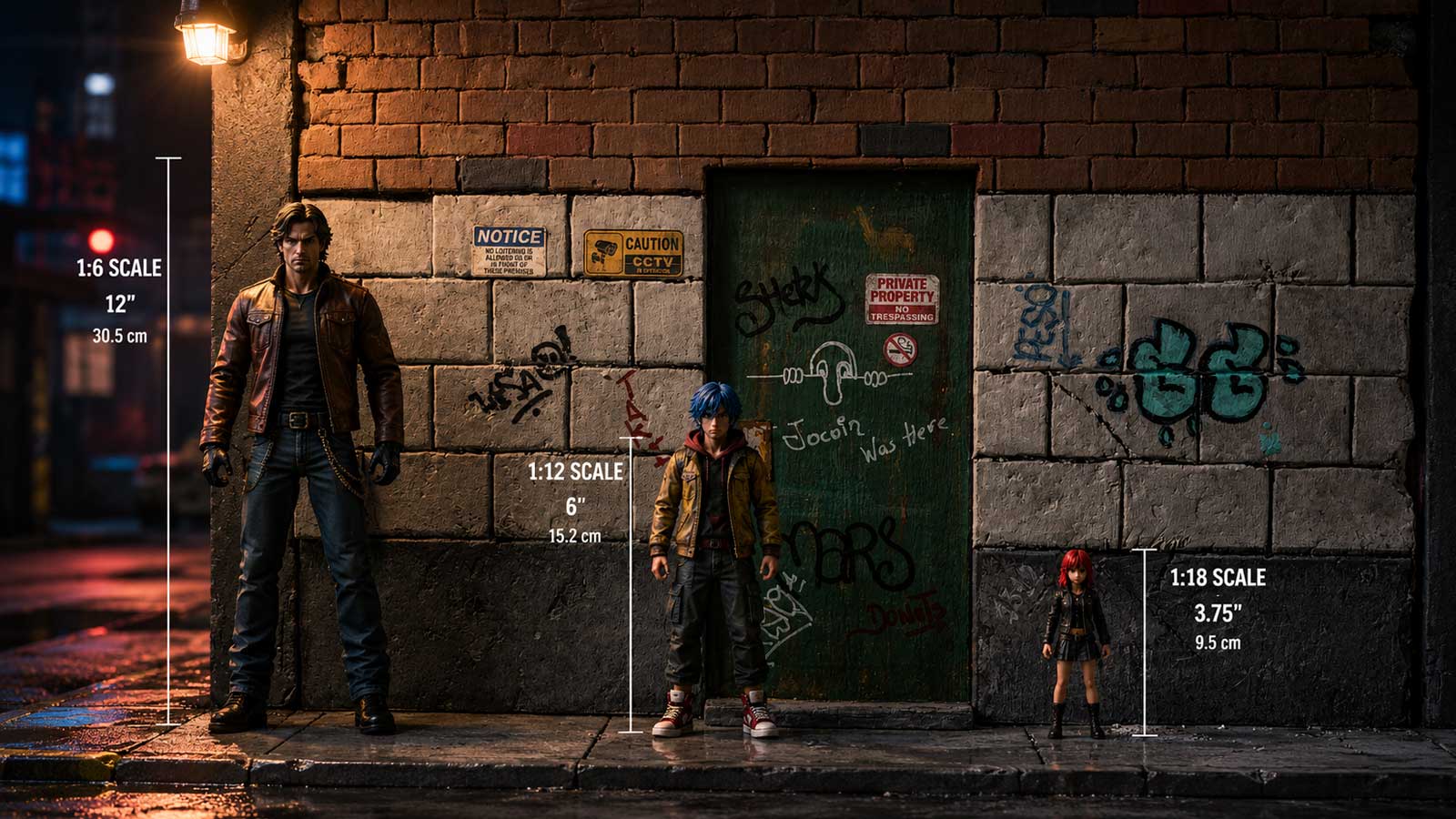
Why Scale Matters in an Action Figure Diorama
A great action figure diorama is not simply a background placed behind a collectible. The figure, environment, props, architecture, and available display space all need to feel like they belong to the same world.
That is why choosing the correct action figure diorama scale is one of the first decisions to make before designing or building a scene.
If the scale is wrong, doors may look too small, furniture can appear oversized, or the figure may feel lost inside the environment. When the proportions work together, even a relatively simple scene can create a much stronger sense of realism and depth.
What Does Diorama Scale Mean?
Diorama scale describes the relationship between the size of an object in the display and the size that object would have in the real world.
For example, at 1:12 scale, one inch in the diorama represents approximately twelve inches in real life. A six-foot person would therefore be represented by a figure roughly six inches tall.
The same principle applies to walls, doors, furniture, signs, props, vehicles, and other environmental details.
Understanding this relationship helps keep the entire scene visually consistent instead of sizing every component independently.
Common Action Figure Scales
Collectors encounter several scales depending on the manufacturer, character, and type of collectible. Some of the most common include:
- 1:6 scale: approximately 12-inch figures.
- 1:10 scale: often around 7 inches, although actual figure height varies.
- 1:12 scale: commonly associated with figures around 6 inches tall.
- 1:18 scale: commonly associated with figures around 3.75 to 4 inches tall.
These measurements are useful starting points, but collectors should not rely on the scale printed on a package alone. Stylized anatomy, unusual character heights, bases, poses, hair, weapons, and accessories can all change the actual dimensions of a collectible.
Is 1:12 a Good Scale for Action Figure Dioramas?
Yes. 1:12 is particularly practical for action figure dioramas because it provides enough physical space for convincing architectural details, textures, props, lighting, and environmental storytelling while remaining manageable for many display areas.
A 1:12 environment can include elements such as brick walls, warehouse structures, rooftop details, doors, pipes, signs, debris, and other features without requiring the enormous footprint that larger scales can demand.
Several environments in the Jocoin Studios Diorama Studio have been developed around 1:12 scale, including urban and industrial scenes designed specifically for collectible figures.
How to Choose the Right Diorama Scale for Your Action Figure
The best scale is ultimately the one that matches the collectible you actually intend to display. Before designing the environment, measure the figure and consider its proportions, pose, accessories, and base.
1. Measure the Actual Figure
Start with the figure’s real height rather than assuming that every collectible marketed under the same scale has identical dimensions.
If the character is permanently posed, measure its maximum height and width as displayed. Large hair, wings, weapons, capes, extended arms, or an integrated base can substantially affect the space required around it.
2. Think About the Environment Around the Figure
A diorama needs more than enough room to physically fit the collectible. It also needs visual breathing room.
A narrow alley, for example, can intentionally surround a figure closely, while a rooftop or warehouse scene may require more open space to establish depth and atmosphere.
Our Warehouse Diorama Design demonstrates how architectural elements and open floor space can work together around 1:12 figures without making the environment feel either empty or overcrowded.
3. Scale the Architecture, Not Just the Props
Small accessories are relatively easy to replace if they look wrong. Architectural proportions are much more important because they establish the visual scale of the entire environment.
Door heights, wall sections, windows, stairs, brick dimensions, railings, pipes, and structural elements should all make sense relative to the figure.
The Brick Wall Street Diorama, for example, uses the surrounding architecture and surface details to establish a believable urban environment around the collectible.
4. Consider the Final Display Space
The figure may determine the scale, but your shelf, cabinet, desk, or display area determines how large the complete diorama can become.
This becomes increasingly important with larger scales. A 1:6 figure may be impressive on its own, but creating a complete architectural environment around it can require considerably more width, height, and depth than a 1:12 or 1:18 scene.
Planning the external dimensions early helps prevent a finished diorama from becoming difficult to display.
Can You Mix Different Scales in the Same Diorama?
Sometimes, but it requires careful judgment.
Two figures labeled as different scales may still look acceptable together because manufacturers interpret character proportions differently. Conversely, two figures sold as the same scale may not look perfectly matched.
The most reliable approach is to compare the actual figures side by side and evaluate them against recognizable environmental elements such as doors, chairs, railings, or walls.
Small differences can sometimes disappear naturally within a scene. Large differences usually become obvious once both figures interact with the same architecture.
Scale Is Only One Part of a Successful Display
Correct proportions provide the foundation, but they do not automatically make a compelling diorama.
Composition, materials, textures, lighting, color, viewing angles, and the relationship between the figure and its environment all contribute to the final result.
This is also where a custom-built environment differs from simply placing a figure in front of a generic background. The scene can be planned around the specific collectible, its pose, and the way the collector wants it to be viewed.
If you are exploring different environments rather than scale itself, our action figure diorama ideas guide covers several approaches for creating distinctive collector scenes.
Planning a Custom Diorama Around a Specific Figure
For a custom project, the figure should ideally be considered from the beginning of the design process.
At Jocoin Studios, the goal is not simply to build a miniature environment at a mathematical scale. The environment also needs to complement the collectible visually and work within the client’s available display space.
That can influence the footprint of the base, height of the background, placement of structural elements, lighting, viewing angles, and how much negative space is left around the figure.
You can explore more examples and information about custom dioramas for action figures or see completed environments in our Diorama Studio.
Frequently Asked Questions About Action Figure Diorama Scale
What scale is best for action figure dioramas?
There is no single best scale for every diorama. The correct scale should primarily match the figure being displayed. For many six-inch action figures, 1:12 provides a practical balance between detail, realism, and overall display size.
Are all 6-inch action figures 1:12 scale?
Not necessarily. A six-inch figure is often associated with 1:12 scale, but character height, stylization, manufacturer choices, poses, and accessories can affect its true proportions. Measuring the actual collectible is more reliable when planning a custom environment.
What is the difference between 1:12 and 1:6 scale?
A 1:6 scale collectible is approximately twice as large in each linear dimension as the equivalent object at 1:12 scale. This means a full environment built around a 1:6 figure can require significantly more display space.
Should I build the diorama before buying the figure?
When possible, plan the diorama around the specific figure. Knowing its exact dimensions, pose, base, and accessories makes it easier to establish appropriate architecture, composition, clearance, and overall display dimensions.
Can a custom display case be designed around the diorama too?
Yes. When the figure, diorama, lighting, and enclosure are considered together, the entire presentation can be designed as one collector display rather than as separate components. Jocoin Studios also creates custom display cases for collectibles built around individual display concepts.
